ALBUM REVIEW
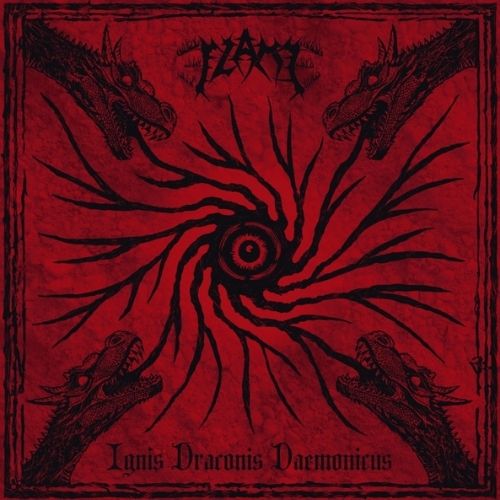
FLAME - Ignis Draconis Daemonicus
Old-school fury comes alive through modern production.
Finland's FLAME return in late September with their third full-length, "Ignis Draconis Daemonicus." Rather than clinging to the roots of black/thrash metal by simply copying them, the band uses the album to demonstrate, in their own way, just how much fire those roots still possess. The riffs are built on the direct aggression of thrash metal, while tremolo guitars, blast beats, and harsh vocals pull the material decisively toward black metal. Yet the band's real character lies not in mechanically placing these two genres side by side, but in their ability to keep thrash's sharp riff discipline and black metal's raw, ritualistic atmosphere within the same compositions. "Ignis Draconis Daemonicus" therefore carries a distinctly old-school character despite its modern production standards; at the same time, it does more than lean on nostalgia, attempting to expand the aesthetic framework FLAME have established previously.
The guitars are the album's defining element. The riffs generally move through short, direct, and sharp figures; particularly in the faster sections, the way tremolo picking locks into the blast beats intensifies the rawness of the songs. Here, it is less black metal's atmospheric approach to the guitar and more its capacity for attack that comes to the fore. When melodic passages enter the picture, however, FLAME's music opens up considerably. These moments, in which old-school black metal riffs are reinforced by melodic variations, are the key factor preventing the album from being built solely around speed and aggression. The solos follow the same approach: rather than embracing flashy modern metal technique, they remain sharp and traditional, firmly rooted in the black/thrash aesthetic of the '80s and '90s.
At this point, the band's Finnish origin alone is not enough to explain the character of the music. "Ignis Draconis Daemonicus" leans more toward the melodic and ritualistic side of Greek black metal; an affinity with bands such as VARATHRON and MACABRE OMEN can be heard particularly in the dark yet anthemic construction of the melodic riffs. The directness of the German black/thrash tradition is also present in the material. However, FLAME do not come across as a band openly imitating these influences; they rearrange the genre's established codes within their own riff economy. In that sense, the album's strength lies less in inventing a new form than in demonstrating that the building blocks of black/thrash, however worn they may have become, can still be made effective.
The rhythm section forms the backbone of this approach. In the faster passages, the blast beats do more than simply support the guitars' tremolo movement; they also determine the degree of rawness in the songs. More groove-oriented hits enter during the mid-paced sections, and these transitions prevent the album from running at full throttle throughout. Even so, this dynamic range is not used equally across every track. Some compositions, particularly in their longer sections, lose structural momentum because they sustain the same riff density without transforming it sufficiently. At nearly seven minutes, "Black Flames Divination" exposes a significant weakness in this regard: FLAME are more convincing when they intensify their ideas rather than expand them.
By contrast, tracks such as "Mystical Voice of My Demon Master" demonstrate why the band should leave more room for melodic and groove-oriented details. The guitar character here is more immediately memorable, while the rhythmic structure supports the identity of the song rather than simply generating speed. "Deification (The Serpent's Promise)" stands out as a more balanced example of this approach. The album's strongest moments, then, are not the sections in which the band simply applies the classic black/thrash formula, but those in which directness and melodic memory meet within the same riff logic.
The vocal approach is another important component of this old-school aesthetic. High-pitched black metal screams and a dirtier, more aggressive vocal character tie the thrash-based riffs to the black metal aesthetic. Yet the vocals are not limited to generating aggression. Spoken passages, whispers, and ritualistic vocal layers appear in certain sections, while the introduction of clean vocals at one point broadens the album's atmospheric scope. Not all of these elements are equally consequential. The sections featuring synths, ritualistic chants, and whispers in particular deepen the atmospheric framework rather than altering the album's underlying riff logic. It is therefore more accurate to describe these elements as controlled atmospheric layers added around an existing black/thrash structure than as an experimental transformation of the genre.
This choice also creates a more meaningful coherence with the album's lyrical direction. FLAME's earlier, more direct blasphemous/satanic approach has given way to a more esoteric language drawing on Thelema, Typhonian and Draconian traditions, Chaos Magick, and Luciferian philosophies. This shift does not transform the fundamental structure of the music, but the ritualistic vocals, synth textures, and atmospheric transitions ensure that the thematic direction is not confined to the lyrics alone. Given the concepts of fire, the dragon, and inner transformation contained in the title "Ignis Draconis Daemonicus," these additions to the album's sonic world do not entirely escape their decorative function, but they do support the thematic framework at certain points.
The production is one of the most important elements allowing this material to hold up under contemporary listening conditions. The sound is sufficiently powerful and heavy without being clean enough to sterilize black metal's characteristic rough edges. The guitars retain their sharpness while the drums carry tangible physical weight, giving the album both the clarity of a professional mix and the angular texture of underground black/thrash. The decision not to over-polish the wall of sound, particularly in the epic passages, is important because FLAME's appeal comes precisely from the tension between this controlled roughness and the more grandiose side of the compositions. Greg Chandler's approach to the mixing and mastering clearly plays an important role here; rather than modernizing the band's old-school character, the production makes it more pronounced.
The album's visual and lyrical world also supports this sonic approach. The Latin title, satanic and occult terminology, and ritualistic sonic elements initially sit very close to the genre's familiar symbolic vocabulary. FLAME's advantage is that they combine these aesthetic codes with the direct aggression of the music. As a result, rather than moving toward the more atmospheric, experimental, or post-black tendencies of the contemporary black metal scene, the album chooses to expand its own scope while retaining the genre's traditional identity.
That is precisely where the problem emerges. The album's consistency occasionally turns into monotony. The succession of fast, filthy, and angular riffs clearly defines FLAME's character, but it also diminishes the impact of dynamic contrast. When the slower and mid-paced sections are given greater prominence, the album gets room to breathe; when melodic ideas enter, the songs acquire a more lasting identity. The area the band needs to develop, then, is not its capacity for aggression or speed, but knowing when to pull those qualities back. After all, the strongest aspect of "Ignis Draconis Daemonicus" is not aggression itself, but the points where aggression intersects with melodic and atmospheric detail.
Rather than joining contemporary black metal's pursuit of novelty, FLAME choose to use the traditional vocabulary of black/thrash as solidly as possible. This approach may not open the album up to a broad audience; for listeners who remain distant from the genre's fundamental aesthetic, the material's sustained intensity may eventually begin to blur together. But the band's apparent goal is less to convince skeptics than to offer a strong alternative to listeners who still take the fundamental principles of this form seriously.
"Ignis Draconis Daemonicus" therefore comes across less as a black/thrash album driven by a nostalgic attempt to revive the past and more as a controlled exercise in showing which details allow the old-school formula to remain alive. FLAME are at their most convincing when they stop treating speed as an end in itself and turn it into a vehicle connecting sharp riffs, melodic guitars, and ritualistic atmosphere. The album could have opened up a much broader compositional field by bringing these details to the forefront more often; as it stands, it shows not so much how far FLAME can push the boundaries of their scene as how firmly they can stand within them. That makes "Ignis Draconis Daemonicus" a FLAME record that brings the rawness of black/thrash together with the weight of modern production, while leaving room for greater impact should the band deploy its strongest ideas with greater restraint and selectivity.

facebook.com/satansflame
primitivereaction.com
primitivereaction.bandcamp.com
facebook.com/primitivereaction666