
ALBUM REVIEW
FLUISTERAARS - Jacht der Mysteriën
Cold, hypnotic, repetition-driven black metal.

Moving away from the experimental strain of Dutch black metal and toward a colder, more Nordic aesthetic, FLUISTERAARS use "Jacht der Mysteriën" not to radically transform the genre’s familiar structures, but to reshape them through repetition and dense atmosphere. Spanning three lengthy tracks, the album establishes a hypnotic flow through thick guitar walls, prominent bass lines, and drums deliberately positioned in the background, while keeping psychedelic and ambient textures around the edges of this framework. What FLUISTERAARS ultimately confront here is how long a limited number of musical ideas can continue to generate compositional tension and atmosphere.
The album’s fundamental compositional approach rests less on riff variety than on the physical effect of repetition. Across its 43 minutes and three tracks, the guitars largely maintain mid-to-up-tempo black metal patterns without substantial alteration; the drums support this movement but remain deliberately recessed in the mix. As a result, rather than rhythmic accents taking center stage, the continuous flow created by the guitars becomes the defining element. Considering the occasionally experimental and genre-blurring character of Dutch black metal, FLUISTERAARS’ choice to pursue a more Nordic, colder, and more traditional aesthetic here marks the album’s first significant point of distinction.
"Grondeloos Donkere Bossen" establishes this approach immediately with its thick guitar tones and layers of atmosphere in the background. While B. Mollema’s high-pitched, throaty vocals retain a familiar black metal mode of expression, T. Cochrane’s bass work is particularly notable for not disappearing beneath the wall of guitars. A clearly audible bass presence is not always a priority in black metal production; here, however, the low frequencies are not used merely to add weight, but also to make the repetition of the riffs more pronounced. The subtle psychedelic textures emerging around the guitars are significant for the same reason. They are not prominent enough to constitute a separate stylistic layer, but they alter the way the constantly repeating riffs are perceived, strengthening the music’s hypnotic quality.

This hypnotic structure becomes even more pronounced on "Condities der Afstraffing". The track draws on black metal’s expectations of speed and intensity, but does not progress through dramatic breaks or pronounced tempo changes. Instead, it opts to sustain the same fundamental movement in a controlled manner. The melodic and melancholic passage from the fifth minute to roughly the six-and-a-half-minute mark is therefore one of the album’s most effective moments. The difference here comes less from the creation of a new musical language than from the existing riff logic briefly acquiring a different melodic weight. It is precisely these small internal shifts that demonstrate why FLUISTERAARS’ compositions cannot simply be dismissed as "repetitive."
Yet the album’s focused structure also creates its most obvious limitation. The fact that all three tracks revolve around similar rhythmic and tonal behavior means that, particularly in the second half, development increasingly gives way to the continuation of repetition. "Zwarte Zomermaan" is the clearest example of this problem. The track’s length allows its central riff to be re-established again and again, while the prominence of the bass increases the physical weight of the cycle. But the line between repetition generating compositional tension and repetition merely filling time is not always maintained.
Moreover, the near-total withdrawal of musical material during the track’s closing section creates roughly eight minutes of emptiness. Given the intensity established throughout "Grondeloos Donkere Bossen" and "Condities der Afstraffing", this choice feels less like an atmospheric conclusion than a compositional reduction. There is nothing inherently problematic about "Zwarte Zomermaan" taking on an ambient character after roughly its tenth minute; the issue is that this transformation is not supported by enough new material to carry the remainder of the track. Even sustaining the same motif through greater variation could have been a more structurally meaningful solution.
Production is an important part of this controlled approach. The fact that the album was recorded in a single take with the full band performing together, then re-amped through the cylindrical structure of an abandoned water tower, helps explain the sound’s shifting character between presence and disappearance. The experimental process does not function like a conspicuous effect added onto the music afterward; instead, it shapes the sense of space and reverberation surrounding the density of the guitars. Still, it is difficult to argue that this approach expands the album’s compositional boundaries. The atmosphere created by the mixing choices of T. Cochrane and M. Koops reinforces the perceptual effect of the existing riff logic rather than transforming it.
The same applies to the album’s folkloric and psychedelic references. FLUISTERAARS’ aesthetic framework, built around the rural environment, local legends, and mysterious lights in the woods, finds its musical counterpart not through the direct use of folkloric melodies but through atmosphere and repetition. The album therefore approaches experimental tendencies within contemporary black metal without directly following them. The psychedelic elements do not alter the structure of the riffs, the atmospheric layers do not reconstruct the song architecture, and the prominence given to the bass does not transform the rhythmic system. Experimentation here is not a compositional rupture, but a way of expanding the sonic space of traditional black metal material.
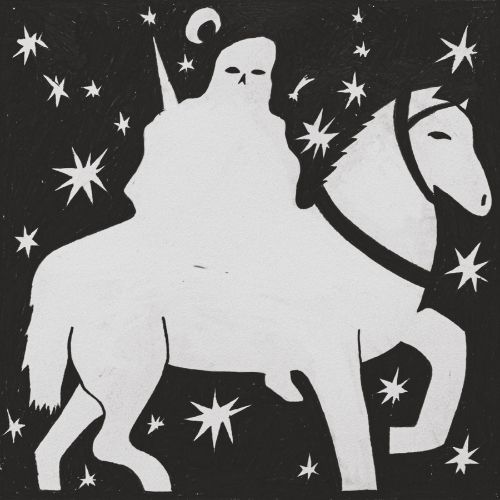
The artwork prepared by B. Mollema can likewise be considered consistent with this approach. Rather than creating an independent spectacle around the music, the visual identity provides a framework that supports the album’s themes of mystery, nature, and uncertainty. In this respect, there is no obvious contradiction between its visual and sonic sides; "Jacht der Mysteriën" establishes itself as a controlled atmospheric work in both sound and presentation.
Ultimately, "Jacht der Mysteriën" is an album in which FLUISTERAARS turn repetition itself into a compositional tool without rejecting black metal’s traditional emphasis on speed and riff density. The effectiveness of this approach, however, depends directly on how the listener responds to repetition. For listeners looking for constant development, distinct hooks, or dramatic structural shifts, the album’s one-directional character is a significant handicap, while a listening approach that allows one to remain within the same musical movement for extended periods brings its guitars, bass, reverberation, and subtle atmospheric shifts into sharper focus. Rather than radically redrawing the boundaries of the genre, FLUISTERAARS deliberately narrow and intensify the existing tools of black metal; the album’s success is ultimately measured by how long it can remain meaningful within that confined space.

https://fluisteraars.bandcamp.com/music