
Album Review
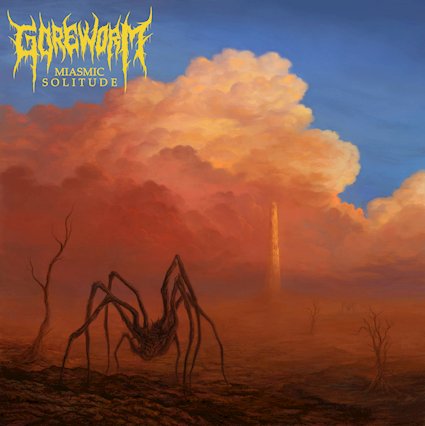
GOREWORM - Miasmic Solitude
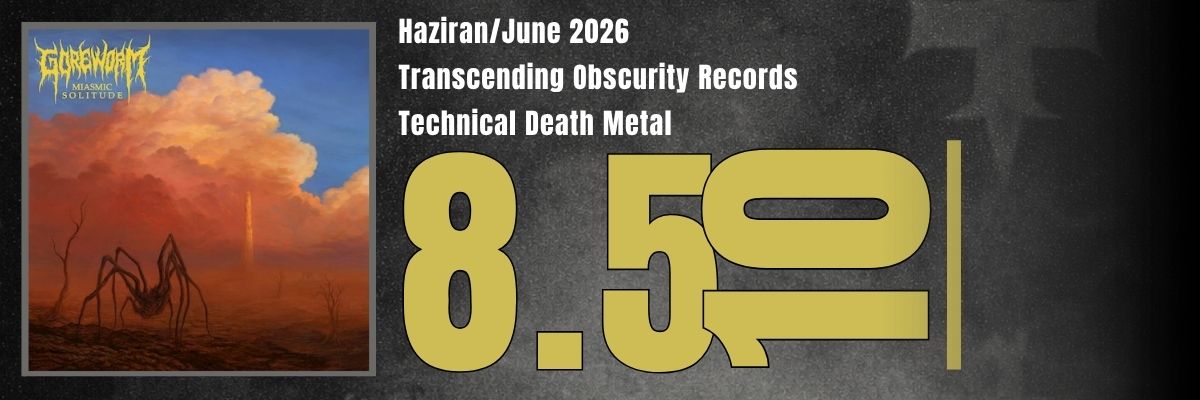
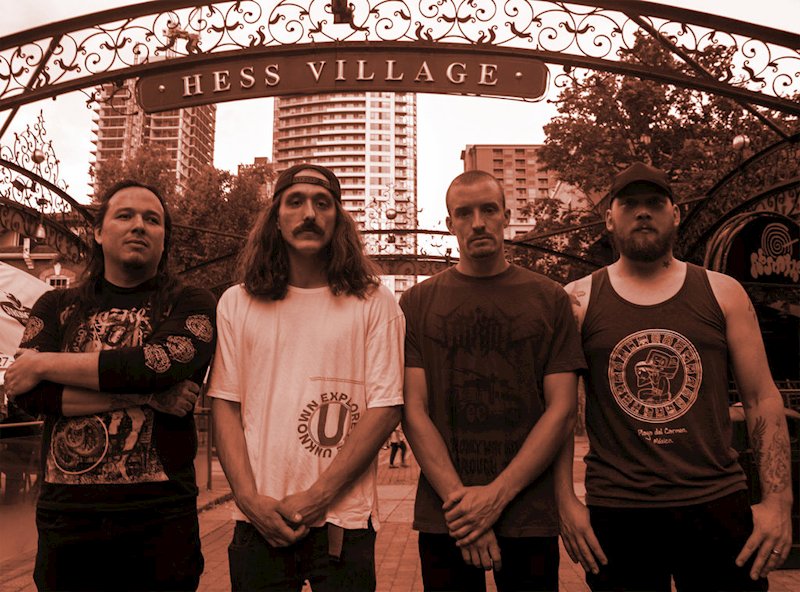
Goreworm is a technical death metal band from Canada, formed in 2017, that stands out for its ability to blend various extreme metal approaches into a single, intense sound.
The album opens with a rhythmic framework that rarely remains anchored to a single state for long. Blast-beat-heavy passages initially establish a sense of speed, yet these sections are constantly interrupted by riff transitions that redirect rather than reinforce the groove. What immediately stands out is that the drums do not function as a fixed skeleton here; on the contrary, they operate like a constant “reset mechanism,” restarting guitar ideas each time within slightly altered timing. Even when grooves emerge, they are treated not as permanent structures but as transient formations.
The guitars move according to a dual logic, alternating between tightly articulated tremolo lines and more angular, chug-based ruptures. While the tremolo passages push the harmonic flow forward, they often disrupt any stable tonal center through chromatic or diminished movement, preventing any clear sense of grounding. When the band shifts into mid-tempo sections, the palm-muted riffs do not merely serve as a slowdown; they reconfigure rhythmic perception, frequently colliding with drum accents and creating the impression that the same measure can be read in multiple ways. In practice, this produces less of a fluid speed–slowdown cycle and more of a continuous negotiation of fragmentation and reconstruction.
The bass guitar becomes most apparent in transitional sections. It mostly doubles the guitar lines to reinforce them, yet in brief intro-like passages it steps forward with clearer articulation before being pulled back into the overall mix. These moments function less as melodic direction and more as brief expansions of the frequency spectrum followed by immediate compression. The production keeps the low end relatively controlled, emphasizing the separation of guitar layers rather than allowing the bass to develop independent trajectories.
The vocals are positioned deep within the mix, functioning more as rhythmic punctuation than as a narrative thread. The performance relies consistently on an extreme vocal register, but the key aspect is its relationship with drum accents. In fast sections, it locks tightly with blast patterns, increasing percussive density. In passages closer to breakdowns, it slightly recedes, leaving rhythmic direction to the guitars, while the vocal layer adds weight rather than defining direction. This approach prevents the vocals from becoming a structurally dominant element, instead embedding them within the rhythmic system itself.
Across the album’s overall structure, repetition is not used for reinforcement. Motifs often return in altered rhythmic contexts or are cut off before fully settling, replaced by new material that shifts tempo, articulation, or harmonic direction. Lead guitar passages are carefully composed, and in tracks like “No Reprieve,” the flow of guitar solos carries the feel of one of the highlight sections of a classical music recital.
What emerges is a listening space where continuity is constantly renegotiated rather than stabilized. Instead of building permanent structures, the album constructs short-lived systems—grooves, tremolo cycles, harmonic cells—and dismantles them before they can settle. As a result, the listener’s focus shifts away from structural climaxes toward transitional moments, where drums, guitars, and vocals are not in a fixed state of agreement, but are continuously repositioned as different interpretations of time and direction within the same compressed framework.
OZY