Album Review
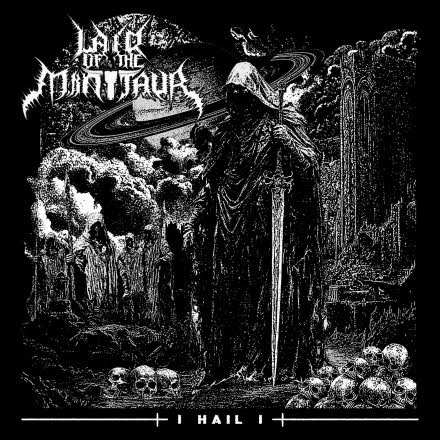
Lair Of The Minotaur – I Hail I
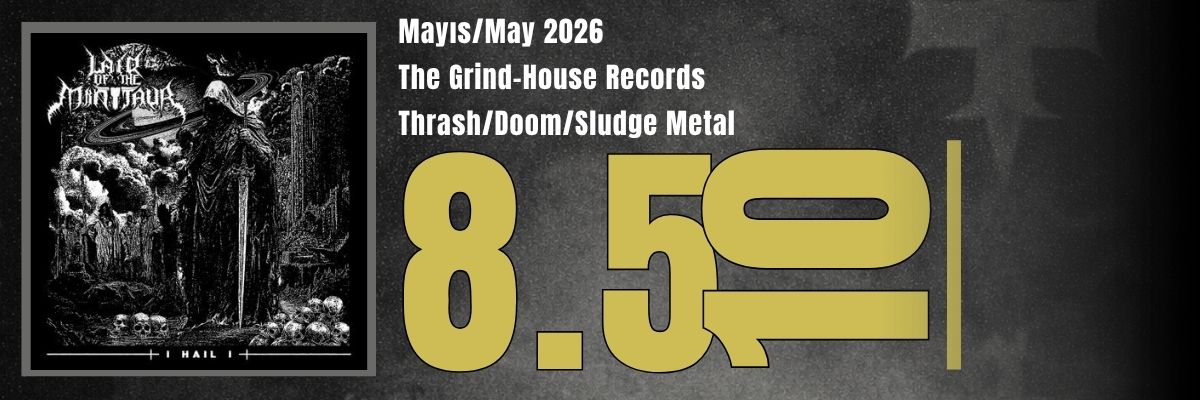
Sixteen years away has done nothing to soften Lair Of The Minotaur’s brute-force riff-writing instincts. If anything, I Hail I reshapes the band’s old sludge/death backbone into something more impatient and more tightly compressed. Most of the songs barely remain inside the same form long enough to stabilize; riffs arrive in short bursts, briefly lock into groove, then get displaced by crust-punk accelerations or sudden rhythmic fractures. Rather than expanding and developing the elements within itself, the album moves forward by forcing them into collision. Mid-tempo death-doom passages are constantly interrupted by d-beat momentum, grindcore-length songwriting, or dragging chromatic repetitions. The result is an album that treats momentum not as something cumulative, but as something expendable.
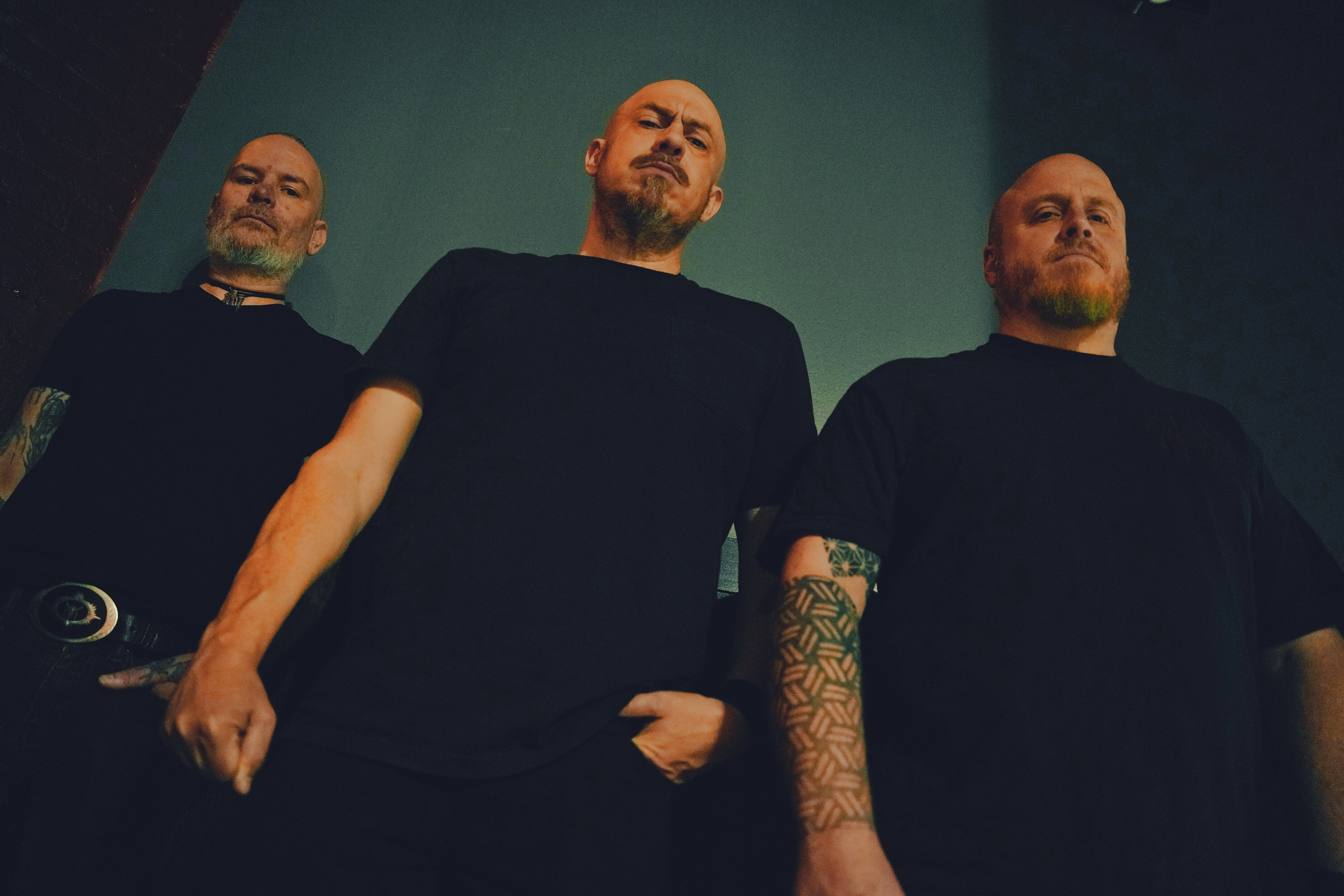
The opening stretch formed by “Emperor Of Dis,” “I Hail I,” and “Fucked Inside Out” immediately establishes that logic. Rathbone’s guitar writing relies on primitive yet carefully weighted riff cycles built around dense palm-muted chugs, bursts of tremolo picking, and descending chromatic runs that refuse tonal resolution for extended periods. The riffs themselves are not particularly complex, but the phrasing continuously shifts around the drum accents, preventing the songs from ever settling into fully stable groove patterns. Wozniak’s drumming becomes crucial here. Rather than reinforcing riff repetition through predictable backbeat structures, the drums constantly push transitions forward with prematurely arriving fills or blast beat-driven momentum shifts. Especially on the shorter songs, this gives the material the sensation of being held together more by impact than by flow. The arrangements resemble hardcore economy filtered through death-doom density.
That tension between movement and weight becomes the album’s greatest strength. While “Enthroned In Violence” and “Prowler Twin Sister” lean more openly into death ’n roll pacing, the groove never fully relaxes. The Entombed influence is particularly apparent in the guitar tone itself — heavily overdriven low-mid frequencies and a filthy, chainsaw-like distortion character — but Lair Of The Minotaur use that tone less as swagger and more as abrasion. The production remains clear enough to preserve separation between the instruments, yet Parker leaves a significant amount of grime around the edges of the mix. The bass guitar does not merely support the guitars; it fills the gaps between riff transitions, constantly sustaining the low-end pressure. As a result, even the simplest sections feel physically congested.
The album gains noticeable power once it slows down. “Saturnus Reign” pushes its rhythmic language into a more oppressive space because the repetitions are allowed to linger rather than constantly mutate. The central doom riff works precisely because the band refuses to decorate it. The guitars repeatedly hammer the same descending riff shape with almost no variation while the drums collapse into a dragging pulse that emphasizes physical weight over technical aggression. Rathbone’s vocals also serve a different function here. During the faster material, his barked delivery behaves almost percussively, sitting high in the mix, whereas the slower sections use elongated roars and guttural placements to create direct tension against the tempo itself. Especially in the moments where gaps open between vocal lines, even silence becomes part of the song’s impact mechanism.
“Tartarus Apocalypse” pushes this approach to its furthest point. At nearly eight minutes, it is the only track on the album that allows motifs to accumulate rather than erupt and disappear. The song moves through extended doom crawls, Celtic Frost-style stomp rhythms, and slow harmonic cycles that approach funeral doom territory without ever fully crossing into it. The crucial detail is that the band never turns this into a progressive showcase. Structural changes occur not through technical exhibitionism, but through shifts in density, drum pacing, or the sustained weight of ringing chords. That simplicity gives the closing section a greater authority than the album’s constantly moving first half.
The experimental detours, however, function less successfully. The reason the Ethel Cain cover of “Family Tree” feels less jarring than expected is because the band reframes the song within its own tonal language rather than treating it like a novelty cover. The colder guitar layers and looser blast beat flow still remain compatible with the album’s overall abrasiveness. “Vulture Worship,” however, detaches itself from the surrounding material. Its industrial percussion loop, synth layers, and electronic rhythmic pulse remove the unstable push-and-pull dynamic that sustains the rest of the album. The issue is not that the track is experimental, but that its rhythmic logic changes entirely. Elsewhere, the album thrives on friction between instruments; here, everything feels overly locked-in and mechanical.
Ultimately, what defines I Hail I is its near-total lack of interest in refinement. Even when the band introduces variation, the songs still revolve around arrangements built on pressure, repetition, and an impact-first mentality. The riffs behave less like evolving ideas and more like objects written to physically occupy space until another section forcibly displaces them. That approach occasionally creates an uneven flow, but it also prevents the album from collapsing into polished retro death-doom nostalgia. Lair Of The Minotaur are not interested in recreating a particular era here; they are focused on preserving a specific form of structural hostility — one that allows groove to emerge briefly, only to deliberately destabilize it again moments later.
OZY