ALBUM REVIEW
GRAVECRAWLER - NIDUS
Dirty, cold, heavy and decaying death metal.
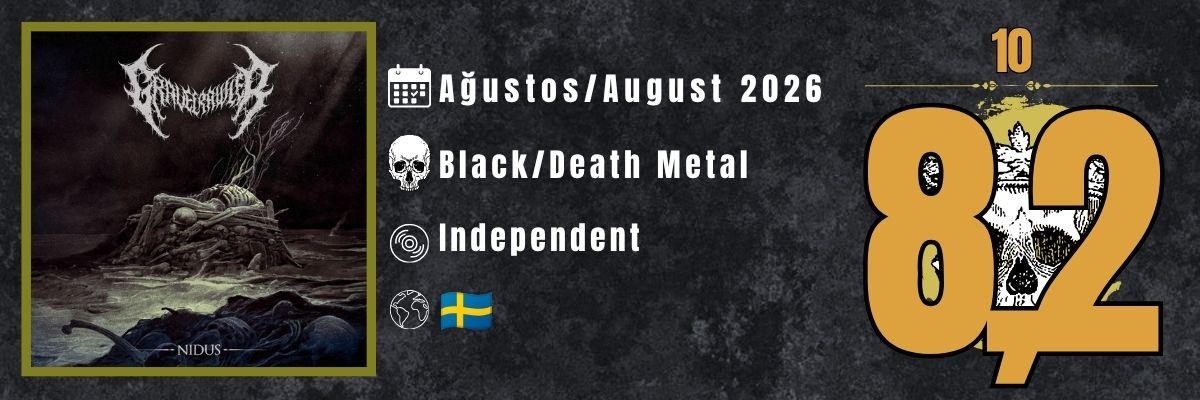
GRAVECRAWLER, hailing from Stockholm, have forged their own dark language by combining the decayed riff legacy of Swedish death metal with the cold atmosphere of ’90s black metal and the sheer weight of slam. Formed in 2019, the band’s demo trilogy and subsequent "ANTHOLOGY: THE HORRORS UNLEASHED" led to "NIDUS", a record that expands this approach into a more ambitious and concept-driven form. Spanning a narrative from the first spark of life to inevitable annihilation, the album reveals GRAVECRAWLER’s attempt not merely to reproduce extreme metal traditions, but to rearrange them within a dirtier, more suffocating context.
The central point of "NIDUS" is not simply the juxtaposition of three different strains of extreme metal, but the way the band transforms this material into a unified aesthetic through production and atmosphere. The guitars’ distinct yet unpolished character, the rhythm section’s balance between crushing passages and faster transitions, and the way the vocals keep two different extreme vocal approaches within the same dark framework all demonstrate that "NIDUS" deliberately distances itself from the sterilized face of contemporary death metal.
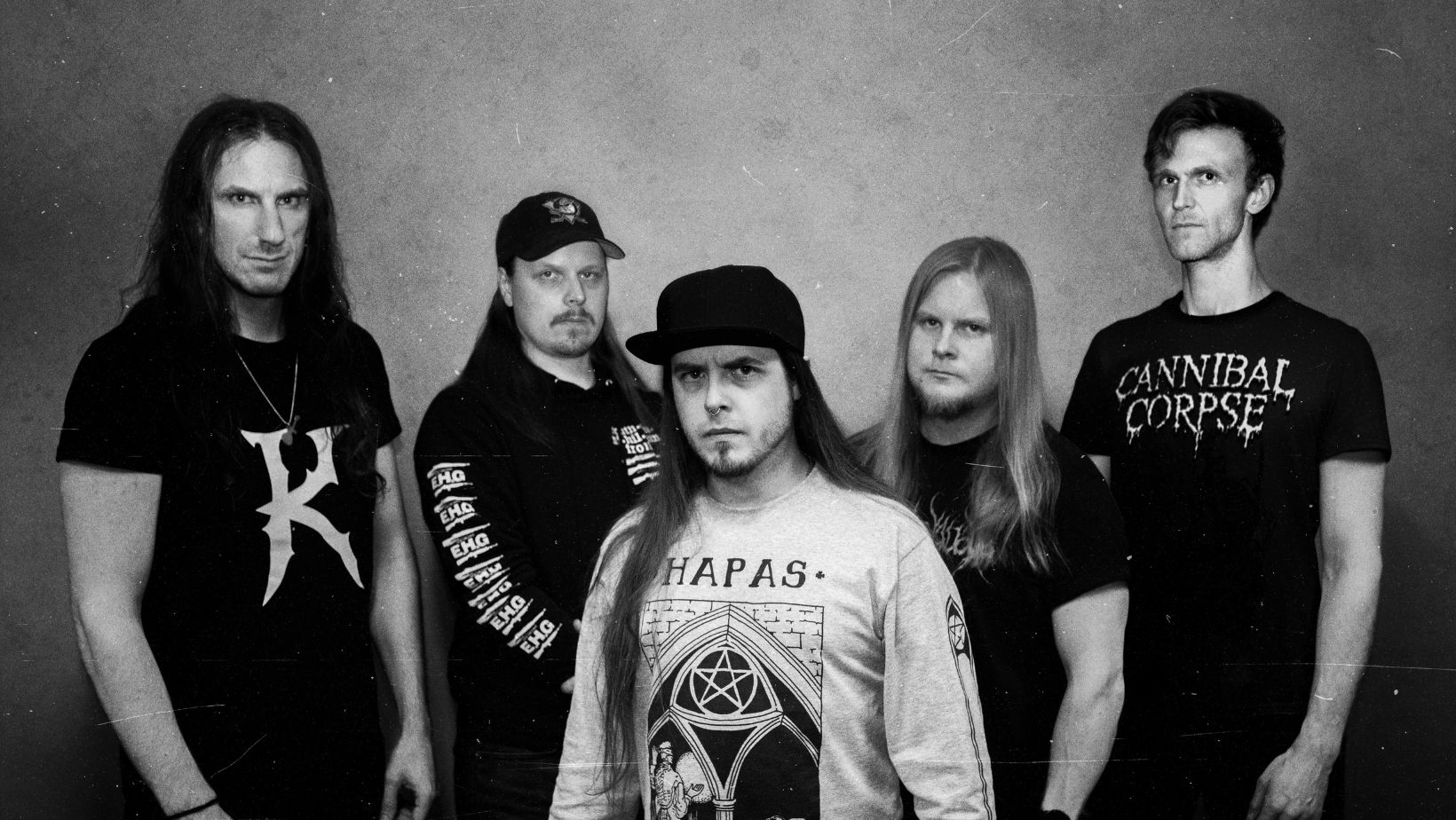
GRAVECRAWLER’s Swedish roots are more than a biographical label attached to the music. While the groove-centered riffing of old-school Swedish death metal is clearly present, the guitar tones push that classic legacy into something denser and more suffocating rather than turning it into a nostalgic reproduction. Jesper Lindgren and Roni Iivonen’s guitars place melody within the dark texture of the riffs instead of treating it as an independent decorative element. Once the album’s black metal side comes into play, the physical weight of death metal and the tonal coldness of black metal become two distinct layers that balance each other. For that reason, "NIDUS" is neither a straightforward revival of Swedish death metal nor something that can be easily filed under the blackened death metal banner.
The band’s use of slam influence is equally measured. Here, slam functions less as a compositional model governing the entire record and more as a tool for pulling the center of gravity of the riffs downward. In certain sections, the heavier rhythmic movement does not interrupt death metal’s flow so much as increase the sheer mass of the material. This choice reinforces GRAVECRAWLER’s claim to be “heavier” not merely through guitar tone, but through their approach to arrangement. Yet the band’s real character does not emerge from the slam side; it lies in the tension between death metal and black metal.
Sebastian Olsson’s drumming is one of the elements carrying that tension. The rhythm section does not simply serve as a backdrop for the guitars; it determines the album’s dynamics by creating transitions between faster and more crushing passages. Roni Iivonen’s bass and guitar work likewise supports that density from below. In particular, the band’s preference for a dirty, low-frequency-heavy approach allows the bass to function as part of the overall mass of sound rather than merely remaining in the shadow of the guitars. The production is not aiming for flawless separation here, but for a density in which the instruments rub against one another without obscuring the fundamental movement of the riffs.
This approach also directly aligns with the DIY character of "NIDUS". The band handled the entire recording and production process themselves. The result stands in opposition to the increasingly prevalent tendency toward excessively clean and controlled production in underground extreme metal. What matters, however, is not simply that the recording sounds “dirty”. The distinction between a dirty tone and uncontrolled sound is crucial here. The production on "NIDUS" preserves the physical weight of the guitars and drums without allowing the atmosphere to disappear. The DIY approach therefore becomes a concrete production choice that supports the album’s aesthetic identity rather than remaining a decorative “underground” badge.
One of the album’s strongest aspects is the coherence between these musical choices and its concept. "NIDUS" is not simply a record that strings together songs with dark themes; its lyrics construct a narrative that begins with the emergence of life and progresses through biological decay, war, environmental destruction, mutation, and eventual cosmic annihilation. The imagery of cellular formation and infection in "Contagion" expands into the depiction of life through primordial sludge and biological competition in "Primordial Sludge". "The Flesh Remembers", meanwhile, brings the cosmic scale of the narrative down to the human body and the trauma of war. The world of the album is therefore not built solely around the idea of “death”; it treats life itself as the starting point of decay.
This idea becomes particularly apparent in the lyrics of tracks such as "Fetid Bloom", "Bogs of Torvus", and "Stagnant". Decaying flesh, swamps, rust, organic growth, and stagnant water continually transform into one another. These organic images also correspond with the band’s musical aesthetic: rather than clean, geometric development, the riffs form heavy, sedimented structures that occasionally grind against themselves. The idea of battlefields being reclaimed over time by plants, mud, and decay in "Bogs of Torvus" is a key part of the album’s relationship between death and regeneration. Death is not the endpoint of the narrative here; it is raw material for another form of life.
"Stagnant" is a more concentrated example of this approach. The images of still water and decaying masses in the lyrics create an idea that appears contrary to the album’s overall sense of movement while remaining entirely consistent with it. GRAVECRAWLER does not use fast extreme metal passages merely as demonstrations of speed; by placing them alongside heavier sections, the band destabilizes the flow itself. As a result, the concept of being “stagnant” remains more than a lyrical metaphor. It finds its musical counterpart in the tension between speed and weight.
The scale also changes in the second half of the concept. In "The Untended Seedling", the idea of mutation and adaptation expands into the planetary and cosmic realm in "Manifest Entropy". At this point, the album’s narrative moves away from a human-centered apocalypse. Roots push into the depths of the planet, stars and orbits begin to break down, and reality itself becomes infected. "Nothingness Awaits" ties this process to the idea of ultimate entropy. The biological decay of the album’s first half thus becomes, in the finale, a miniature model of dissolution on a cosmic scale.
At this point, the conceptual structure of "NIDUS" also takes on musical significance. The death/black metal combination employed by GRAVECRAWLER already provides fertile ground for contrasts between life and death, movement and decay, aggression and atmosphere. By incorporating these oppositions into the concept, the band connects genre formulas to a thematic framework. The album’s concept therefore does not exist as a story detached from the music; it provides an aesthetic rationale for why the music needs to sound this dirty, cold, and heavy.
Jesper Lindgren and Billy Lundevall’s vocal work should also be considered within this framework. Rather than establishing a melodic center, the vocals emphasize the physical side of the narrative. This choice allows the biological and cosmic imagery in the lyrics to function less as something to be directly understood and more as a language of aggression within an extreme metal context. GRAVECRAWLER’s vocal approach consequently does not create a separate dramatic layer above the music; it becomes integrated into the dark mass established by the guitars and drums.
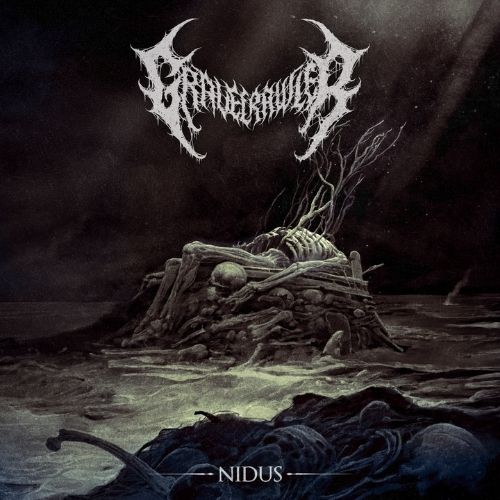
The album’s visual and conceptual world follows the same direction. Even the title "NIDUS" evokes ideas of a nest, formation, and development, while the lyrics remove that concept from any sterile image of birth and place it within a framework of infection, mutation, and decay. This is consistent with the band’s belief that “extreme metal was never meant to be clean or safe”. The aesthetic here is not merely an imitation of the dirty appearance associated with old-school extreme metal; it gains meaning because it converges with a concept that treats life itself as a substance susceptible to corruption.
GRAVECRAWLER’s position within the contemporary underground becomes clearest here. Direct references to the Swedish death metal tradition represented by bands such as Bloodbath and Grave coexist with Incantation’s darker death metal language and Devourment’s slam-heavy approach, yet the band does not fully adopt the formula of any one of them. Once the cold atmosphere of black metal is added to the combination, the result feels less like a genre fusion than a structure in which different extreme metal traditions are melted together within the same aesthetic of decay. This is where GRAVECRAWLER’s distinguishing quality lies: rather than claiming innovation through new instrumentation or unconventional techniques, they establish their identity by changing the density and context of familiar genre materials.
The trade-off is that the album is not entirely without risk. Material drawn from such firmly established death metal, black metal, and slam traditions can easily become overshadowed by its references if the balance is not right. The success of "NIDUS" lies not in making those influences invisible, but in turning the friction between them into part of the album’s identity. Even so, the band’s most distinctive quality lies less in innovation at the level of individual riffs than in their ability to bring all this material together under a coherent atmosphere and concept.
Ultimately, "NIDUS" is not simply an album that chooses to be “dirtier” in opposition to the polished production and genre-fusion tendencies of contemporary extreme metal. GRAVECRAWLER turn the groove-driven weight of old-school Swedish death metal, the cold tonality of ’90s black metal, and the crushing rhythmic mass of slam into musical tools for a narrative that progresses from the emergence of life toward entropic annihilation. The album therefore positions itself less as a genre showcase to be consumed quickly than as a work that demands attention to the connections between riff weight, rhythmic shifts, dense production, and concept. GRAVECRAWLER are not breaking down the boundaries of the genre here; they are rearranging the material within those boundaries into something darker, dirtier, and heavier.
