

EP REVIEW
I DENY - İnfial
Harsh, direct, political, and furious hardcore.
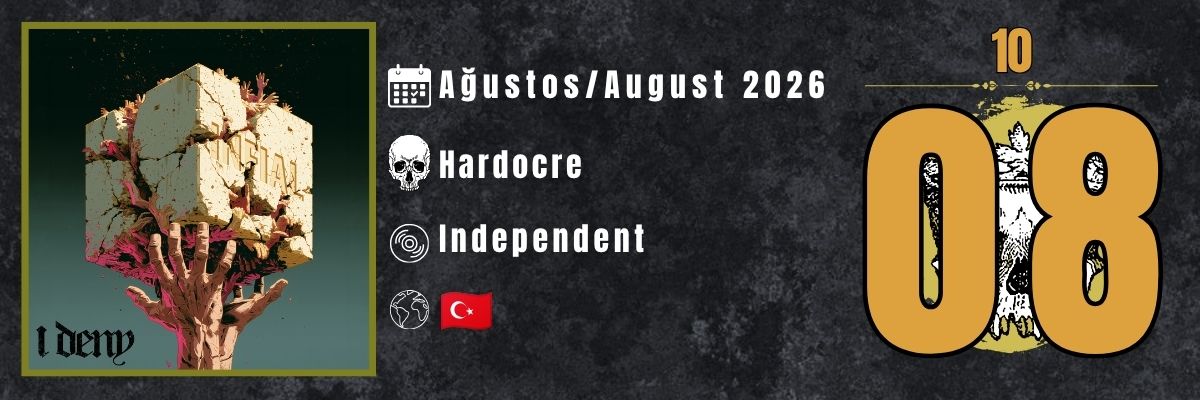
Representing the hard-hitting and direct strain of Turkey’s hardcore scene, I DENY channels both the rhythmic and physical nature of the music and its lyrics into an expression of the anger felt by both the band and the society it inhabits on their new EP, "İnfial". Across its four tracks, this short release addresses conflicts ranging from hypocrisy to social injustice through Turkish lyrics, combining hardcore’s traditional aggression with a tighter production. I DENY’s second EP, "İnfial", makes the band’s musical and intellectual side—one that brings personal experiences and social observations together on the same plane of intensity—even more pronounced.
Following our increasingly familiar approach, if we are to give the record a brief summary, the band does not engage in unnecessary attempts to expand hardcore’s fundamental principles or open a new door on the EP. Instead, it sharpens them within a compressed form. Spanning four songs, the recording moves through high-tempo drums, a harsh guitar tone, direct vocals, and sections whose rhythmic weight is intensified particularly through breakdowns. The record’s fundamental preference is intensity over variety: the tracks are kept short, ideas are conveyed as directly as possible, and the physical energy carried by the music is placed on the same line as the political stance of the lyrics.
At the center of this approach are Kaan Karasu’s guitars. Rather than allowing the dark tone to open the riffs into a melodic space, it places the emphasis on rhythmic impact, while Göksel Eriştirenoğlu’s drums define the EP’s range of movement between high-tempo passages and rhythmically fractured sections weighed down with heaviness. The use of breakdowns in particular on "Yüzüme Bak" points to an arrangement philosophy aimed directly at hardcore’s live-performance-oriented side. These sections stand out not merely as transitions that slow the song down, but as tools that alter the shape of its energy. What I DENY offers listeners here is a rearrangement of the genre’s traditional mosh-oriented structure within a contemporary, tighter production approach, without abandoning it.
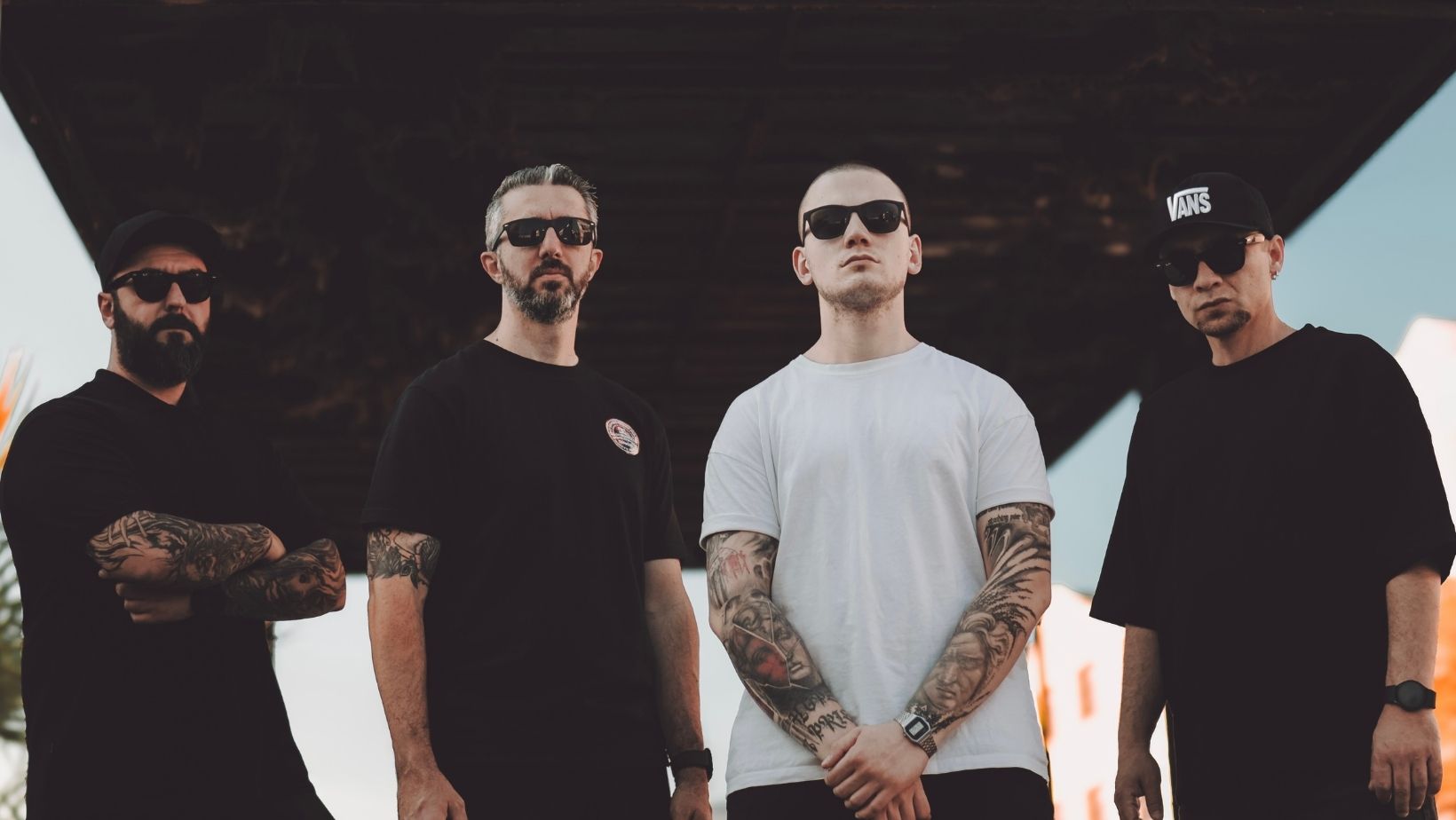
On bass and vocals, Onur Ağar’s role is another important component of this intensity. Rather than disappearing into the same frequency range as the guitars, the bass supports the rhythmic backbone, reinforcing the compactness required for an EP this short. Ağar’s approach, having also taken on mixing and mastering duties, indicates that the band was aiming for a more dynamic and tighter result compared with its earlier work. Even so, the production’s purpose is not to completely polish away hardcore’s raw character. While the dark guitars and raw vocal character remain intact, the separation between the instruments prevents the recording from becoming an uncontrolled wall of sound. Consequently, "İnfial" does not place the clarity afforded by modern production ahead of the genre’s underground aesthetic.
Arda Özgültekin’s vocal performance, meanwhile, defines the band’s lyric-centered approach. Singing in Turkish here is not merely a language choice, but part of the music’s communication strategy. Rather than obscuring its lyrics behind indirect metaphors or excessively literary imagery, I DENY expresses concepts such as anger, confrontation, oppression, and injustice directly. For that reason, the harsh and unfiltered character of the vocals cannot, of course, be considered independently from the rhythmic aggression of the guitars; it carries the message of the lyrics to the same point as the physical weight of the music.
"Riyakâr" opens the door to this approach at high speed. The idea of betrayal and hypocrisy at the song’s center is met musically with an introduction built on directness. What is particularly striking about I DENY here is that, rather than enlarging the theme to create a dramatic atmosphere, the band surrenders it to hardcore’s short and sharp mode of expression. The song establishes the language of the conflict that will unfold across the rest of the EP: identify the problem in front of you, name it, and refuse to back down.
"Yüzüme Bak", meanwhile, carries a more pronounced sense of physical confrontation. Built around reckoning and defiance, the track becomes one of the EP’s most performance-oriented points in rhythmic terms thanks to its breakdowns. Pulling the weight downward after the fast sections employs one of hardcore’s fundamental mechanisms of tension: movement created through tempo culminates in a physical emphasis through rhythmic breakdown. The track’s potential effectiveness in a live setting therefore stems not only from its high energy, but also from an arrangement that takes audience response into account.
At 2:59, the EP’s longest track, "Leş Düzen", opens up a broader space narratively despite its relatively short runtime. Exploitation, injustice, and systemic criticism move beyond personal confrontation here and settle directly into a social framework. An important choice in the band’s songwriting also becomes apparent at this point: the political stance is not turned into an abstract protest aesthetic. As I DENY explicitly states, the record draws from personal experiences and events the band has observed in its surroundings, and it puts that fact right in our faces. For this reason, the anger of "Leş Düzen" draws its strength not from repeating hardcore’s historical protest tradition, but from the band’s direct relationship with the social environment in which it exists.
"Çıkmazın İçinde" carries one of the EP’s most pronounced tensions between lyrics and music. Alongside themes of pressure, imposition, and mental struggle, its focus on refusing to surrender and choosing one’s own way of staying on one’s feet prevents the track from becoming merely a dark conclusion. The critical point here is that the band expresses this idea not through melodic resolution, but through hardcore’s language of aggression and rhythmic intensity. As a result, the feeling of helplessness arises not from the music slowing down, but, on the contrary, from the intensity that keeps the pressure going.
This is also where "İnfial" is strongest lyrically. Across its four tracks, hypocrisy, confrontation, exploitation, injustice, oppression, and alienation do not appear as disconnected themes; they form different points along a line drawn between personal experience and social structure. While "Riyakâr" and "Yüzüme Bak" employ a more personal language of confrontation, "Leş Düzen" foregrounds systemic criticism, while "Çıkmazın İçinde" turns back toward the individual’s position within this mechanism of oppression. This sequence demonstrates that the EP is not simply a matter of placing four protest songs next to one another.
At the same time, the directness of the lyrics is a double-edged choice. I DENY’s aim is not to construct complex imagery or multilayered poetic narratives, but to convey its message as unfiltered as possible. In a hardcore context, this consistency provides a significant advantage, because the rhythmic aggression of the vocals and the straightforward language of the lyrics serve the same model of communication. On the other hand, this approach leaves less room for interpretation when the texts are read independently of the music. The lyrics of "İnfial" derive their primary strength not from literary detail, but from the directness they acquire when delivered alongside the music and shouted at full volume.
This places I DENY firmly within the protest-oriented strain of Turkey’s hardcore scene. The band retains the genre’s fundamental vocabulary, its use of breakdowns, and its concert-centered sense of energy; consequently, "İnfial" makes no claim to a radical break with the genre. Its value lies more in how tightly this traditional framework can be executed. In particular, keeping Turkish vocals and local social observations at the center of the music allows the band to build its identity not only through musical references, but through its manner of expression as well.
On the visual side, the cover artwork by Nesrenjake and the "Riyakâr" video prepared by 0mm can be regarded as extensions of the band’s sense of directness beyond the music itself. Yet the decisive factor here is not so much the visual world adding a new meaning to the music as it avoiding any contradiction with the raw and protest-oriented character of the recordings. The emphasis on the message and performance rather than unnecessary showmanship in I DENY’s aesthetic choices is consistent with the EP’s overall approach.
"İnfial" is therefore not a work that seeks to redefine hardcore’s boundaries through experimental tools. More interesting is the way the band combines the tools the genre already possesses—fast drums, heavy rhythmic breakdowns, harsh guitars, and direct vocal delivery—with political and personal lyrics along the same compositional axis. Its short runtime works in the EP’s favor as well; rather than expanding its ideas, it compresses them. Ultimately, listeners are not asked to embark on a patient process of discovery, but to actively respond to the rhythmic and lyrical directness of the tracks. If we are to address the EP’s weak point at this stage, the work is heavily in search of a hit track. With "İnfial", I DENY has raised expectations in the eyes of its followers, and if it delivers one or several clear-cut hit tracks in its future work, it will not only solidify its position within Turkey’s hardcore scene, but also carve out a visible place for itself on a global scale.
The fundamental move I DENY makes with "İnfial" is not to invent a new hardcore language, but to embrace the existing one without compromise. The EP’s position within the contemporary scene is shaped from this point as well: it preserves the genre’s traditional protest-driven and live-oriented character while updating it through more controlled production and compact arrangements. Rather than seeking innovation through an increased number of instruments, this record looks for it in keeping the functional connection between music and lyrics as tight as possible across each of its four short tracks.
