ALBUM REVIEW
KROLOK - Hričov-Súľov-Lietava
Slovak history becomes black metal form.
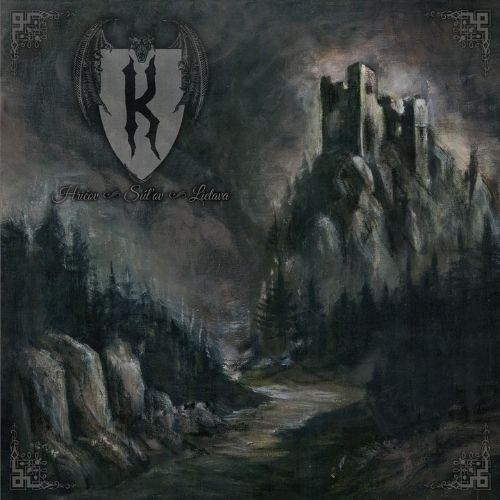
Slovakia’s ancient castles are not merely the theme of a black metal album this time; they also determine its musical map. With “Hričov-Súľov-Lietava”, KROLOK places the three castles named in the title, the roads between them, and the surrounding historical atmosphere within a six-track structure. Hričov, Súľov and Lietava correspond directly to the album’s three long black metal compositions, while the three shorter pieces positioned between them create transitional spaces where the music can breathe. The record therefore does more than attempt to create a historical atmosphere; it turns geography directly into part of its form.
This approach becomes apparent within the first few minutes. At around fourteen minutes, ‘Hričov’ spreads virtually every tool KROLOK employs here across an expansive opening space. Acoustic guitar, dynamic riffs, keyboards, percussion, blast beats, fanfares, spoken passages and environmental sounds all serve different functions within the same composition. The quieter, more theatrical atmosphere at the beginning eventually connects with classic black metal riffs and harsher rhythmic sections. The melodic, march-like transitions in particular evoke the ceremonial and fantastical aesthetic of early-1990s black metal, yet KROLOK does not leave it at mere nostalgic imitation. The song’s length occasionally creates the impression that the same idea is being held for longer than necessary, but in terms of understanding the rest of the album, it functions as a kind of musical gateway.
An important choice KROLOK makes here is not to completely separate its harsher sections from its atmospheric passages. When the pace accelerates, tremolo guitars and blast beats push the music directly toward old-school black metal, while keyboards, acoustic guitar, folk elements and melodic leads add different shades to that framework. The keyboards generally expand the atmosphere in the background rather than acting as the primary force driving the compositions. This distinction matters, because the album’s theatrical side never completely overtakes its black metal identity.
The other side of the arrangement emerges in ‘Pod Skalnou bránou’. In this short instrumental passage, acoustic guitar and warm-sounding bass loosen the dramatic intensity of the preceding track. The music does not function here as an interlude preparing for the next assault, but as a transition that carries a distinct sense of place in its own right. Light dungeon synth overtones and folk-inflected touches establish the album’s historical atmosphere not directly through riffs, but through space and timbre.
‘Súľov’, which follows, brings the black metal side of the album back to the forefront. Its guitar motif is more immediately memorable, moving between mid-paced sections and blast beats. KROLOK is not chasing complexity here; instead, it relies on a handful of fundamental riffs being used within different rhythmic and atmospheric contexts. That simplicity is an important part of the band’s old-school approach. At the same time, however, it also exposes one of the album’s limitations. The repetition of certain passages, particularly given the song’s length, can slow the progression of the composition rather than heightening its dramatic impact.
This structure at the album’s core also explains why “Hričov-Súľov-Lietava” is not designed like a conventional sixty-minute black metal flow. ‘Dolu Váhom’ disperses the weight of the preceding track as a short transition built around acoustic guitar and folk-inflected tones. As a result, the distance between the three main compositions is felt not only in terms of duration, but also through instrumentation and intensity. The pronounced contrast heard throughout the record prevents the atmospheric sections from becoming merely decorative interludes. Silence and sparse arrangements create a sense of movement rather than waiting; the idea of a route progressing from castle to castle finds its musical equivalent within the structure itself.
As the third of the three main compositions, ‘Lietava’ leans into a more direct black metal form. Tremolo guitars, blast beats and dark vocals bring the album’s core genre identity back to the foreground, while keyboards and orchestral touches in the background prevent the song from turning into a monotonous assault. Spoken passages and certain guitar effects also add a sense of historical theatre to the arrangement. The atmosphere here is more controlled than the more elaborate and showy composition of ‘Hričov’. As the final of the three main pieces, it therefore preserves the album’s structural balance.
The closing track, ‘Posledný zárez v čase’, takes the music somewhere else after all this movement. A keyboard theme approaching the boundaries of dungeon synth and dark ambient creates a sparser conclusion after the black metal intensity of the preceding sections. The drums’ more peripheral role also makes the track’s function clear: this is not about technical display, but about the atmosphere dissolving. The music becoming less dense and darker toward the end, considered alongside the broad dynamic range established at the beginning, gives the record a distinct arc.
The vocals add another important contextual layer to this structure. “Hričov-Súľov-Lietava” stands out as KROLOK’s first recording to feature Slovak-language lyrics. Since ancient Slovak legends, Carpathian castles and the region’s historical memory lie at the album’s centre, this change remains more than a linguistic choice. The harder consonantal structure of Slovak, particularly when combined with the black metal vocals positioned further back in the mix, turns the lyrics into part of the music’s texture rather than something that is always immediately intelligible. Occasional clean or spoken-style vocals further expand this narrative space.
The album’s production, meanwhile, preserves its old-school character rather than pushing the aesthetic toward a modern, polished black metal standard. The guitars and drums are sufficiently powerful, yet the recording is not completely sterile; atmospheric layers and raw black metal textures can coexist within the same mix. The contrast between the intensity created by tremolo and blast beats in the faster sections and the openness of the acoustic guitar, folk instruments and ambient passages defines much of the album’s dynamic character. The record therefore cannot simply be reduced to a search for an “old-school” sound. The production also leaves enough space to carry the album’s historical and theatrical side.
The classicist black metal approach rooted in KROLOK’s past is still clearly audible here. The melodic and rhythmic legacy of early Norwegian black metal, touches of Slavic folklore and the aesthetic of dungeon synth meet within the same framework. Yet the album’s real distinguishing feature lies less in the number of its references than in the way they are arranged. The short, sparse and atmospheric passages placed between the longer compositions written for the castles connect the album’s subject directly to its compositional method. Reading “Hričov-Súľov-Lietava” merely as a collection of old black metal sounds would therefore miss an essential part of what it is doing.
That coherence does not mean every track is equally strong. While ‘Hričov’, with its breadth and wealth of ideas, is the composition that occupies the most space on the album, ‘Súľov’ occasionally moves away from the record’s distinctive atmosphere because of its more traditional black metal structure. Reducing some of the riff repetition in the longer passages could have made the album’s dramatic construction tighter. At the same time, the use of the shorter pieces balances this issue to a significant degree, because rather than stacking the dense sections one after another, KROLOK deliberately interrupts the album’s momentum.
The value of “Hričov-Súľov-Lietava” therefore cannot be found solely in its cold black metal riffs or folkloric details. KROLOK does not merely use a particular historical geography as the album’s backdrop; it transfers the movement of that geography into the sequencing of the songs. Three castles, three transitional spaces and the pronounced differences in intensity between them turn the theme into musical form. For a black metal project fifteen years into its existence, that is where the real point of development lies: rather than simply repeating the dark aesthetic it established in the past, it now binds that aesthetic more tightly to the memory of a specific geography through a more cohesive compositional logic.
“Hričov-Súľov-Lietava” is a work that shows KROLOK can use folk, dungeon synth, ambient and theatrical narration within the same structure without breaking away from its classic black metal roots; a record that turns its local history into more than a subject, making it part of the music’s very form.

All Digital Links: https://bfan.link/KROLOK-Hricov-Sulov-Lietava