
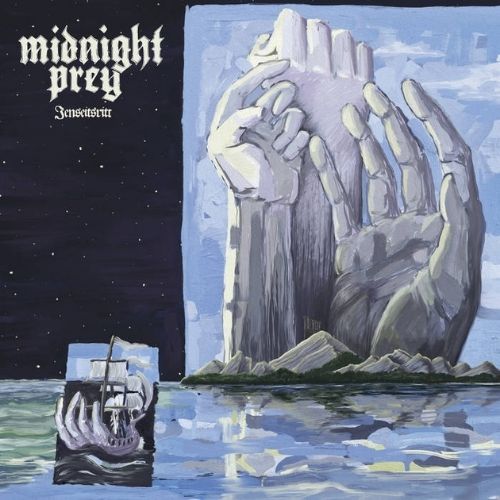
ALBUM REVIEW
MIDNIGHT PREY - Jenseitsritt
Raw, energetic, genre-bending, riff-driven, distinctive.

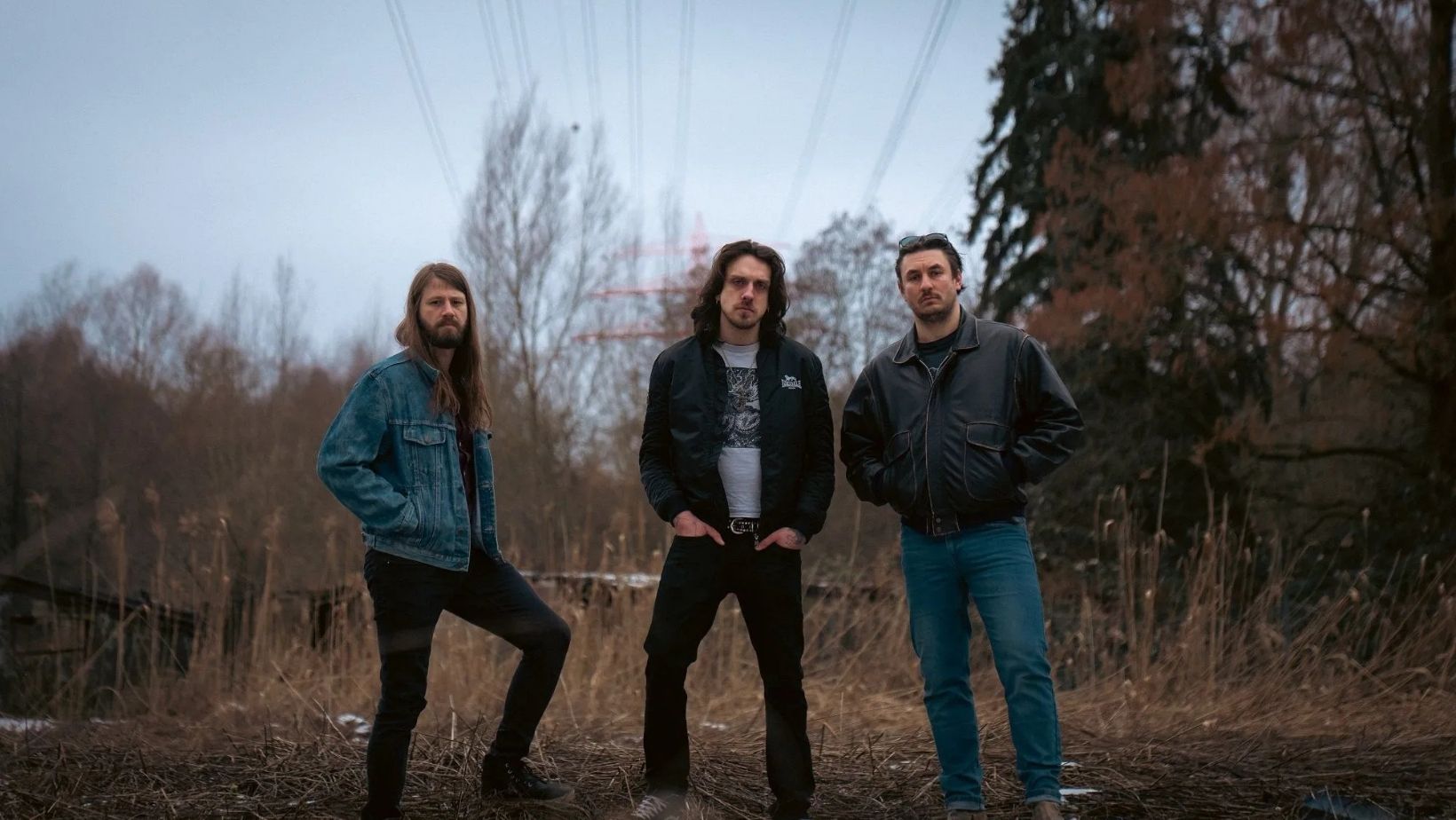
MIDNIGHT PREY, hailing from Hamburg, finally return with their second full-length, "Jenseitsritt", after a hiatus of nearly seven years, drawing on the boundaries and common ground between metal, punk, and speed metal. The first detail that stands out is the trio's sound: clean enough to retain clarity, yet still dirty and raw, without excessive polish. Rather than smoothing off the edges of the riffs, this approach puts the guitar's attack and the fluctuations of its sound across the strings front and center. Winston Ziller's guitars are therefore more than a melodic vehicle; they are the primary force shaping the album's rhythmic tension. Daniel Friesen's bass lines and Hannes Ruhland's drumming, meanwhile, never disappear behind the guitars. The fact that all three instruments remain distinctly audible is one of the production's most effective aspects.
"Grimoire" brings this approach into clearest focus. Its fuzzy guitar tone moves away from the clarity traditionally associated with heavy metal from the very first seconds; galloping rhythms and hard-hitting accents then pull the track toward speed metal. Ziller's vocals likewise refuse to stick to a single technique. Guttural, rasping, and at times throat-driven bursts are used less to establish a melodic vocal line than to add different degrees of intensity over the riffs. The dramatic impact of the vocals therefore comes not only from the delivery itself, but from the contrast they create with the guitars' sharp and restless character.
"Torn Into Pieces" takes a different route, placing a simpler chord progression at the core of the song. That basic motif expands through branching riffs as the track develops; while the band maintains a direct and tightly controlled rhythmic framework, they also allow the guitars to broaden the space with ideas that interlock with one another. Darker riff touches and the lead guitar work in the later sections disrupt the punk-rooted directness the song initially presents. This reveals one of MIDNIGHT PREY's key strengths: they can generate movement through the sequencing and density of their riffs without resorting to unnecessary time-signature changes simply for the sake of complicating their songs.
"Witch King" pushes this approach into a more aggressive rhythmic framework. Rolling toms and huge guitar chords give the opening a heavier weight, while thrash-oriented passages later in the song alter both the tempo and emphasis. The blast beats toward the end further demonstrate that the band has no intention of confining itself to traditional heavy metal formulas. Yet these shifts never feel like random jumps between genres. Because the rhythm section preserves the melodic and harmonic ideas carried by the guitars, the song's internal cohesion remains intact.
"Kaspar Hauser", with its German lyrics, presents a more debatable point within this framework. Its immediate structure and largely 4/4-based drum pattern make it more static than the constantly shifting energy of the preceding three tracks. The guitars' undulating texture and the early vocal entrance give the song character, but there are fewer structural surprises. As a result, "Kaspar Hauser" is not a bad song so much as a more limited composition when placed alongside the more dynamic arrangements elsewhere on the album.
"Unknown Trails" immediately closes that gap. Its double-kick patterns, rapid riffs, and prominent bass lines from Friesen do more than simply increase the pace; they create a separate field of movement in the lower frequencies. The guitars continually reshape the song by moving between free-flowing passages and tighter, more aggressive sections. Ziller's vocal bursts also function as a kind of rhythmic marker throughout these transitions. The song's ability to combine punk-rooted mobility with speed metal velocity within the same structure is one of the clearest examples of MIDNIGHT PREY's position between these genres.
"Starlit Nebulas" brings the album's heavy metal side further into focus. The opening riffs have a more traditionally melodic character, while Friesen's bass lines, following the main guitar melody, reinforce the song's melodic backbone. The fact that the riffs remain more immediately memorable despite the guitars' dirty tone is significant; MIDNIGHT PREY use melody as a clearly defined compositional element rather than burying it inside the production. Short but effective solo sections further support the song's classic metal side. The band's increased intensity in the second half, coupled with Ziller's more dramatically charged vocal performance, keeps the track from becoming a static heavy metal pastiche.
"Jenseitsritt", meanwhile, brings the album's different sides together within a single structure. Rolling double-kick patterns lock tightly into the bass and guitars, while rhythmic accents give the song a more pronounced groove. Melodic motifs woven between the guitars and chords occasionally left to ring out create breathing room between the denser riff passages. This use of space is important, because the album never maintains the same level of intensity throughout. The song establishes its own dramatic flow by alternating hard guitar blocks with more open sections. The brief solo toward the end also remains functional within this structure; rather than being extended for showmanship, it serves the song's closing section.
Ziller's vocal approach plays a particular role in the album's position between genres. It never fully embraces the controlled melodic delivery of traditional heavy metal, but neither does it surrender entirely to hardcore's purely rhythmic and direct attack. Particularly in the German-language songs, the harsh, vulnerable, and at times elegiac delivery prevents the vocals from functioning as an independent layer simply placed on top of the music. This approach, reminiscent of the more unconventional vocal traditions of German metal represented by bands such as DEPRESSIVE AGE, makes MIDNIGHT PREY's transitions between punk and metal all the more pronounced.
The real achievement of "Jenseitsritt" lies not in listing different genre references, but in the band's ability to connect them within the same riffing logic. The openness inherited from 1970s hard rock, the melodic thinking of traditional heavy metal, the speed of speed metal, and the directness of hardcore punk are not placed in separate compartments. Instead, they change functions across different sections of the same songs. At a time when much of contemporary extreme metal is moving toward increasingly dense production, tighter low-end control, and more immaculate guitar tones, MIDNIGHT PREY's slightly rougher and more organic approach functions almost as a deliberate counterpoint. The rawness of the guitar tone in particular helps preserve the music's live-performance energy.
For that reason, reading "Jenseitsritt" simply as a crossroads of classic heavy metal, speed metal, and punk influences would be insufficient. What defines the album is not how new these elements are, but how naturally the band is able to make them operate within the same rhythmic and melodic system. That range narrows in certain sections—particularly on "Kaspar Hauser"—but tracks such as "Grimoire", "Witch King", "Unknown Trails", and "Jenseitsritt" demonstrate that the band does not treat direct riff writing and structural variation as opposing ideas.
Ultimately, MIDNIGHT PREY choose to preserve the physical character of their instruments rather than move toward the polished production standards of the contemporary metal scene. "Jenseitsritt" shows that this is not merely a nostalgic aesthetic choice; it is embedded directly into the compositions through the guitar tone, the audibility of the bass, the drum transitions, and Ziller's shifting vocal technique. The album demands a form of listening that follows the changing direction of the riffs, the way the rhythm section repositions itself alongside the guitars, and the effect of the raw production on the compositions, rather than fixing its attention on a single genre. That is precisely where MIDNIGHT PREY's distinctiveness emerges: instead of simply adding genres together, they render the boundaries between them meaningless through the internal movement of their songs.
