Album Review
TELOCH VOVIN - Towards The Inevitable
For New York’s TELOCH VOVIN, Towards The Inevitable is more than an album attempting to expand black metal’s aggression; it is a work that tries to reorganize chaotic intensity through ritualistic and symphonic layers. The central idea behind the record is built less on merging traditional black/death metal destructiveness with ambient, doom, and classical textures, and more on dissolving these disparate components within the same aesthetic of decay. Yet the album’s true character emerges not from how “grand” these ideas are, but from how deliberately unruly and uncontrolled their execution chooses to be.
The opening track, “His Creation Reversed,” functions directly as a preparatory sequence through electronic drones and ominous atmospheric transitions. The album’s actual framework becomes apparent with “The Rite Ov The Harvest Pt 1: The Rite Ov The Reaper’s Blade”: thin yet razor-edged guitars occasionally lose the physical weight of the riffs due to an excessively treble-heavy production. The mixing choices create a two-sided effect here. On one hand, the filthy and unrestrained character of the guitars reinforces the material’s necrotic atmosphere; on the other, especially during faster passages, it causes the riffs to blur together, obscuring the rhythmic backbone of the compositions. TELOCH VOVIN’s conscious refusal to sterilize chaos is palpable, though the album occasionally places this rawness ahead of structural clarity.
The vocal approach follows the same trajectory. While the transitions between high-pitched black metal shrieks and guttural vocals feel familiar within classic black/death hybrids, the goal here is less about creating contrast and more about sustaining a constant level of assaultive intensity. Particularly on “Samael - Lord Ov The Second Death,” the hymn-like passages do more than reinforce the band’s occult aesthetic on a lyrical level; they slow the rhythmic pace of the track and allow the guitars to move within a more ceremonial space. The doom influence manifests directly in the riff construction: tremolo-driven aggression gives way to slower-moving chord progressions with wider intervals and delayed resolutions.
One of the album’s more striking aspects is the unusually prominent presence of the bass within the mix. Particularly on “A Dirge To The Death Ov Life, Love And Hope Pt 2,” the low-frequency weight carried by the bass becomes the primary element balancing the guitars’ thinner tone. The track’s occasionally amateurish transitions and scattered flow actually reveal that the band is not operating through a completely control-oriented compositional mindset. At times this strengthens the dramatic ruptures within the songs; at others, it creates the impression that ideas are abandoned before they are fully developed.
The album’s defining statement, however, is undoubtedly the nearly sixteen-minute “Panzer Fist.” Black metal has relied on symphonic arrangements for decades, yet TELOCH VOVIN’s approach functions somewhat differently from the traditional “epic backdrop” formula. The viola, violin, and cello layers are not used merely to generate atmosphere; they become structural tools that shape the track’s dynamic directional shifts. Especially in the opening section, where battlefield effects dominate, the machine-gun tremolo patterns of the guitars constantly collide with the orchestral textures. At times this collision generates genuinely overwhelming tension; at others, it disperses the song’s focus.
What makes “Panzer Fist” most effective is its ability to establish multiple centers of gravity within itself rather than continuously escalating. The album does not move solely through speed or chaos here; march-like rhythms, doom-laden slowdowns, motifs evoking Eastern melodies, and ritualistic bell usage transform the piece into a multilayered suite. Particularly in the middle section, the drums’ near-stomp character and the wider harmonic spaces left by the guitars allow the orchestral layers to genuinely reshape the composition. At this point, the classical instrumentation moves away from the territory of “decorative symphonic metal” and becomes integrated into the song’s dramatic architecture.
Still, the album’s experimental aspects are not always equally effective. The ambient transitions and electronic layers sometimes expand the atmosphere, while in other moments they function merely as connective tissue between tracks. TELOCH VOVIN’s real strength emerges less through detailed orchestration than through intensity control. The band does not place black/death metal’s familiar aggression at the center of its interpretation; instead, it relocates it within a more ceremonial, militaristic, and chaotic aesthetic.
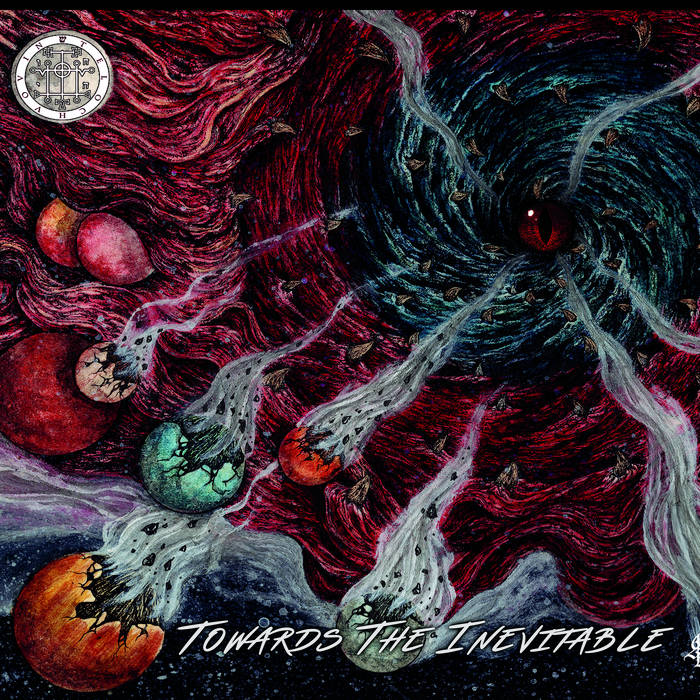
The album’s visual identity reinforces this approach as well. The occult and war-driven language of the cover artwork directly aligns with the music’s constant fixation on death, collapse, and destruction. What is particularly interesting here, however, is that the band’s visual aesthetic never slips into the modern “cinematic black metal” approach. The imagery remains tied to the crude, threatening, and ritualistic side of underground — even distinctly ’90s — black metal culture, creating a coherent unity with the album’s deliberately unpolished production choices.
Towards The Inevitable is an album that consciously chooses to remain disorderly in opposition to contemporary black metal’s increasingly clean, controlled, and post-production-heavy methodology. At times this decision weakens the impact of the riffs; at others, it grants the music a genuinely disturbing character. TELOCH VOVIN does not radically redefine the genre’s boundaries here, but it does sharpen its own identity by pushing black/death metal’s warlike and occult core into a more theatrical, multilayered, and ceremonial form. The album does not ask the listener to tolerate its technical imperfections; it asks them to accept how those imperfections function as part of the record’s chaotic architecture.
OZY