ALBUM REVIEW
THÆTAS – The Irredeemable Age
An avant-garde approach to brutal death metal.
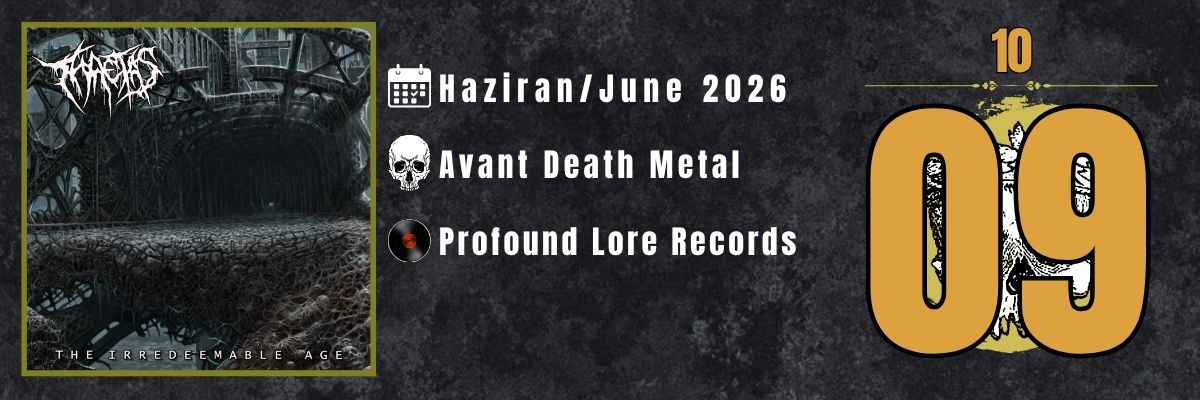
Founded in New York in 2015, THÆTAS has carved out a distinctive place among a new generation of bands seeking to reshape brutal death metal through dissonance, rhythmic instability, and an avant-garde compositional philosophy. Their 2020 debut Shrines to Absurdity drew attention by prioritizing organic chaos over technical exhibitionism, and with their sophomore full-length The Irredeemable Age, the band refines that aesthetic into something more focused and deliberate. Without compromising the fundamental brutality of the genre, the album broadens the band's compositional scope and presents the clearest expression of THÆTAS' artistic vision to date.
Despite its relatively concise runtime, The Irredeemable Age establishes itself from the opening minutes through constantly shifting riff architecture, abrupt rhythmic fractures, and an organic production style that is built not around technical showmanship but around controlled structural unease. While preserving the familiar density of brutal death metal, the album achieves its intensity not through relentless blast beats and mechanical complexity alone, but through a compositional language in which riffs continually destabilize one another, tonal centers repeatedly dissolve, and nearly every section introduces a new direction. The result is not an arbitrary attempt at sounding avant-garde, but a coherent artistic vision that embeds chaos directly into the architecture of the songwriting.
The most notable evolution on The Irredeemable Age is THÆTAS' decision to pull back slightly from its technical death metal instincts in favor of a more fluid compositional approach. The calculated rigidity that occasionally surfaced on the debut gives way to more organic transitions. The riffs still mutate constantly, but they no longer rely solely on speed or note density; instead, they move naturally from palm-muted groove passages into dissonant ruptures, from slam-inflected collapses to unexpected thrash-driven bursts. This approach makes the record easier to follow without smoothing away its inherently chaotic identity.
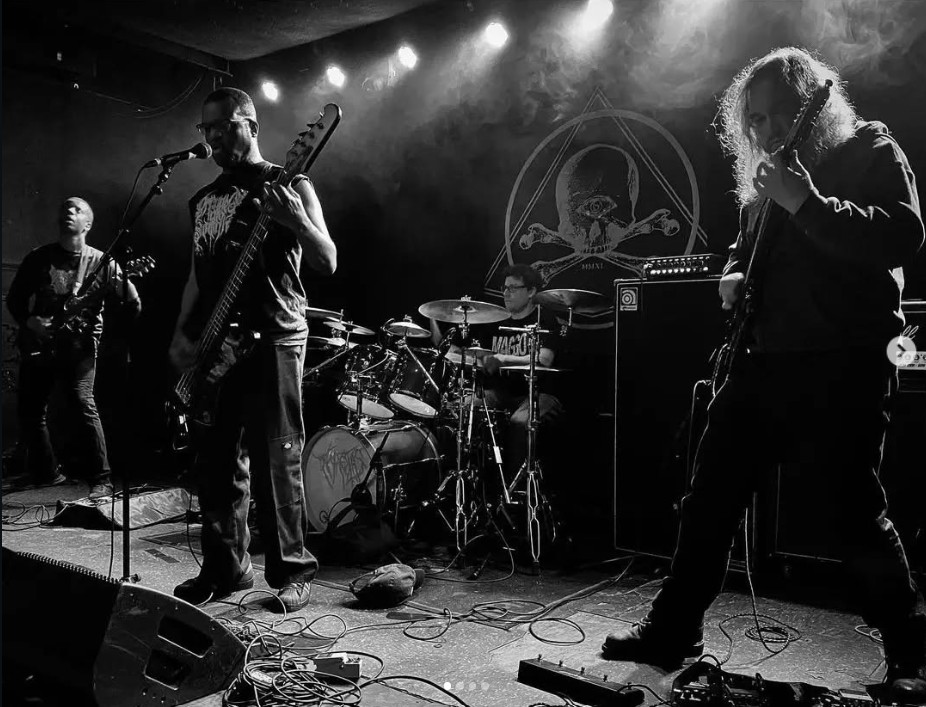
The guitar work remains the defining force behind the album. While echoes of Suffocation, Defeated Sanity, and latter-era Gorguts are unmistakable, THÆTAS succeeds by establishing its own rhythmic balance rather than merely imitating those influences. Dissonant chord clusters repeatedly infiltrate otherwise familiar brutal death riffing, allowing phrases to suggest resolution before abruptly shifting into different accents or time signatures. "Summer Of Hate" and "The End Of History" are particularly effective in fusing aggressive thrash-oriented attacks with warped harmonic language, creating some of the album's most dynamic moments. Pinch harmonics are employed with greater restraint than on the band's debut, while chaotic lead guitar lines weaving through the upper register sustain an almost constant sense of tension.
Although technically accomplished, the drumming never dominates the mix, instead serving the constantly shifting momentum of the riffs. Despite the abundance of blast beats, the album's impact is never rooted in speed alone; sudden tempo drops and crushing slam accents allow the constantly evolving guitar work room to breathe. This dynamic becomes especially apparent in the arc stretching from the opening track "Dhukha" to the closing "Digital Locusts." As the album progresses, the rhythmic framework grows increasingly fragmented, yet THÆTAS never completely abandons its mosh-oriented brutal death instincts, preventing the listener from losing their footing entirely.
The bass also steps beyond the largely invisible role it often occupies on technical brutal death records. Most notably on "Digital Locusts," its prominent runs do far more than reinforce the low end; they introduce an independent melodic tension that actively interacts with the guitars' dissonant movement. That decision becomes one of the album's key strengths, preventing its densely layered arrangements from collapsing into a one-dimensional wall of sound.
Vocally, THÆTAS remains firmly rooted in the traditional brutal death metal aesthetic. The deep guttural performance never reaches for theatricality, functioning instead as another embedded layer within the instrumental turbulence. Rather than occupying the foreground, the vocals become part of the overall sonic mass, meaning the album's dramatic weight emerges less from lyrical delivery than from the structural pressure generated by its riffs and rhythmic disruptions.
Perhaps the album's greatest strength is that its avant-garde ambitions are realized not by introducing unusual instrumentation or superficial experimentation, but by stretching the compositional logic of brutal death metal from within. Brief acoustic passages and fleeting atmospheric spaces remain largely decorative, while the real distinction lies in the way the riffs connect, evolve, and transform. THÆTAS never drifts into completely free-form improvisation; every composition retains a clearly defined brutal death framework beneath its complexity. That discipline separates the album from many contemporary releases whose experimental aspirations ultimately come at the expense of compositional focus. Across its roughly thirty-minute runtime, ideas emerge, develop, dissolve, and give way to new ones with remarkable efficiency, yet the density never devolves into an uncontrolled display of technical excess.
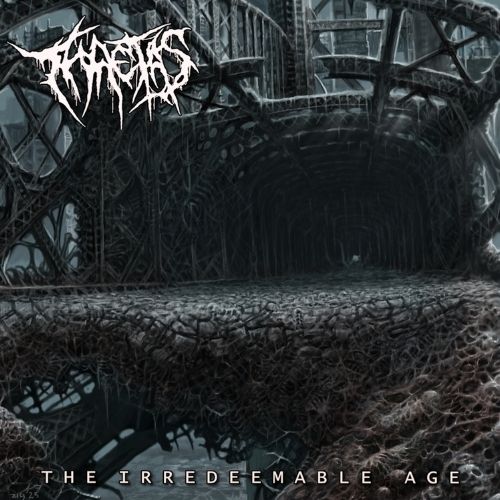
Colin Marston's mixing and mastering further reinforce this philosophy. Rather than embracing the sterile digital sharpness often associated with modern technical death metal productions, the album opts for an organic sense of weight and density. Individual details remain intact even as the instruments grind against one another, allowing the dissonant guitar layers and the physical heft of the rhythm section to coexist in careful balance. Jon Zig's cover artwork complements this approach as well, communicating themes of abstract decay and societal collapse through a fragmented, deeply unsettling visual language rather than through literal representation, ultimately reinforcing the fractured aesthetic at the heart of the music.
The Irredeemable Age does not seek to radically redefine the boundaries of brutal death metal. Instead, it pushes the genre's existing vocabulary toward something more fluid, more organic, and structurally less predictable. THÆTAS' most significant achievement is transforming experimentation from a superficial marker of identity into the very foundation of its compositional philosophy. As a result, this is a record that will resonate less with listeners searching solely for technical proficiency than with those interested in how structural tension and rhythmic instability can be meaningfully developed within brutal death metal, ultimately securing THÆTAS a distinctive position within the contemporary avant-garde wing of the genre.
OZAN
https://www.instagram.com/thaetas_bdm
https://www.facebook.com/THAETAS
https://www.youtube.com/@thtas8990
https://profoundlorerecords.com
https://www.profoundlorerecords.bandcamp.com
https://www.instagram.com/profoundlorerecords