
ALBUM REVIEW
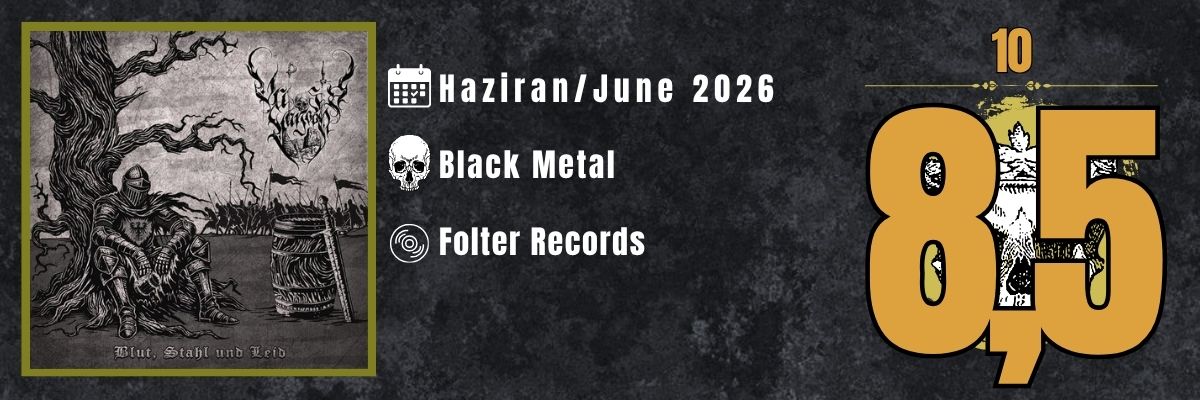
Valosta Varjoon – Blut, Stahl und Leid
Black Metal caught between raw riff architecture and controlled rhythmic tension
Valosta Varjoon presents an approach on “Blut, Stahl und Leid” that reconstructs the raw aesthetics of Black Metal through controlled grime and rhythmic severity. The album reshapes the genre’s classic tension—oscillating between blast beat intensity and mid-tempo riff blocks—within a punk-inflected field of motion. The sense of darkness rooted in regional texture keeps the music away from atmospheric clichés, defining it instead through direct riff organization.
“Blut, Stahl und Leid” opens with a riff logic that builds Black Metal through atmosphere, yet refuses to rely solely on the “atmospheric” label. The guitar writing largely moves between two poles: sharp tremolo-based motifs aligned with high-speed blast sections, and heavier, mid-tempo, rock-oriented riff blocks positioned against them. These transitions are not used simply to create tempo shifts, but to fragment the internal dynamics of the tracks and generate layered shifts in character. Especially in the opening passages, this fast-to-mid-tempo oscillation disrupts early Black Metal aesthetics with a punk-influenced rhythmic looseness, moving the music closer to a sense of raw execution rather than technical discipline.
The drum performance sits at the center of this dual structure. While the blast beats maintain a standard level of intensity, they do not form a constant plane; instead, they redirect the tracks through groove-leaning accents in mid-tempo transitions. This gives the rhythmic foundation a more “human” swing, particularly when the guitars drift into rock’n’roll-leaning riff figures. The fact that the drums are neither overly sterile nor deliberately primitive aligns with the album’s overall production philosophy: a controlled roughness.
The vocal approach is positioned as one layer within the mix rather than a dominant focal point. This high-pitched shriek-like vocal style functions more as an atmospheric texture than a foreground element, especially within dense guitar walls. This choice shifts the center of gravity away from vocal expression toward riff organization, reducing Black Metal’s theatrical vocal tradition to a more functional role.
The album’s melodic dimension develops through small motifs embedded directly within the riffs. In tracks such as “Reise ins Gestern” and “Im kalten Moor,” this becomes more pronounced: instead of establishing distinct melodic lines, the guitars extend repeating motifs through subtle variations. This method turns melody into a structural tension device rather than a thematic statement. Particularly in slower sections, these repetition cycles create a sense of static compression rather than forward compositional movement.
One of the album’s most notable aspects is the occasional infiltration of punk and early rock-influenced riff articulation into the classic blast/tremolo language of Black Metal. These elements do not remain purely aesthetic accents; in some tracks, they partially redefine the rhythmic backbone. However, it is not always accurate to say this influence fully transforms the compositions. In certain passages, the punk character remains a surface-level energy layer rather than a structural shift in direction—functioning less as a compositional driver and more as a textural contamination of the existing framework.
The structural backbone of the album is generally based on a linear song form. Rather than building clear “theme-development-resolution” dramatizations, the tracks progress in blocks where the same ideas are repeated at varying intensity levels. While this approach supports the album’s claim to rawness, it also limits dynamic variety in certain areas. In particular, the absence of dramatic breaks during extended mid-sections suggests that some riff ideas do not fully realize their potential.
Production is built on a deliberately dirty, granular surface. The guitars are concentrated in the low-mid frequencies, which occasionally obscures clarity but does not disrupt cohesion. The bass rarely steps forward as an independent layer, instead functioning as reinforcement for the guitar wall. This choice strengthens the album’s “local and unpolished” character while also preventing full resolution of finer details. In denser passages, the mix occasionally softens instrumental separation to the point where small details are lost.
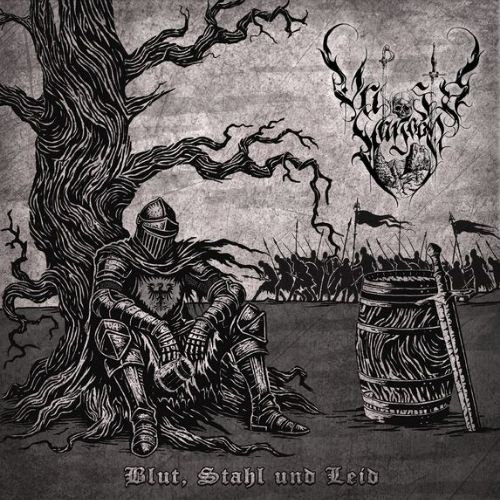
The visual and conceptual framework of the album is based on a deliberate distancing from Scandinavian Black Metal iconography. Instead of forests, mythology, or theatrical darkness, it emphasizes regional texture—stone, dampness, small-town reality. While this approach generates a sense of place that supports the riff-driven rawness of the music, it does not consistently translate into structural depth within the compositions themselves. The visual identity therefore functions more as an external frame than an organizing principle embedded in the music.
Ultimately, “Blut, Stahl und Leid” stands as a work that reworks early Black Metal aesthetics through punk-influenced riff movement and controlled production grime, yet does not always convert these ideas into full compositional transformation. The album builds a consistent character through its resistance to technical sterility, but in several sections this character operates below its potential due to repetitive riff blocks and limited structural ruptures. As a result, the listener is presented not with an ever-expanding form, but with a deliberately contained Black Metal narrative in which the same material is recontextualized at varying intensities.
OZAN